

Most women who start running in January are not running in March. Not because they lacked willpower. Because they built their habit around motivation, and motivation is unreliable. The weeks when running feels easy, anyone can do it. The question is what happens when work is heavy, sleep is short, and the last thing you want to do is put on your shoes.
That is the week that makes or breaks the habit.
Start smaller than you think you should

The most common mistake is starting with too much. A new runner commits to four days a week, 30 minutes a run, and is exhausted and behind schedule by week two.
A better approach is the smallest version of a run you could actually do on a bad day. For a lot of women, that is 15 to 20 minutes, two or three times a week. If you are genuinely starting from zero, even shorter is fine. The guide on how to start running as a complete beginner walks through the first few weeks in a way that will not break you.
The point is not to see how much you can do. It is to see what you can repeat.
Attach running to something that already happens
Habits form faster when they hook onto an existing part of the day. Not “I’ll run sometime in the morning,” but “I run right after I drop the kids at school” or “I run before I shower on Tuesday and Thursday.”
- Pick a window that already exists in your routine.
- Prepare the night before. Shoes out, clothes ready. Remove the friction of deciding.
- Treat it the same way you treat a standing work call. It is just what happens then.
This works because you are not waiting for motivation. You are following a cue.
Use run-walk intervals, not an all-out pace
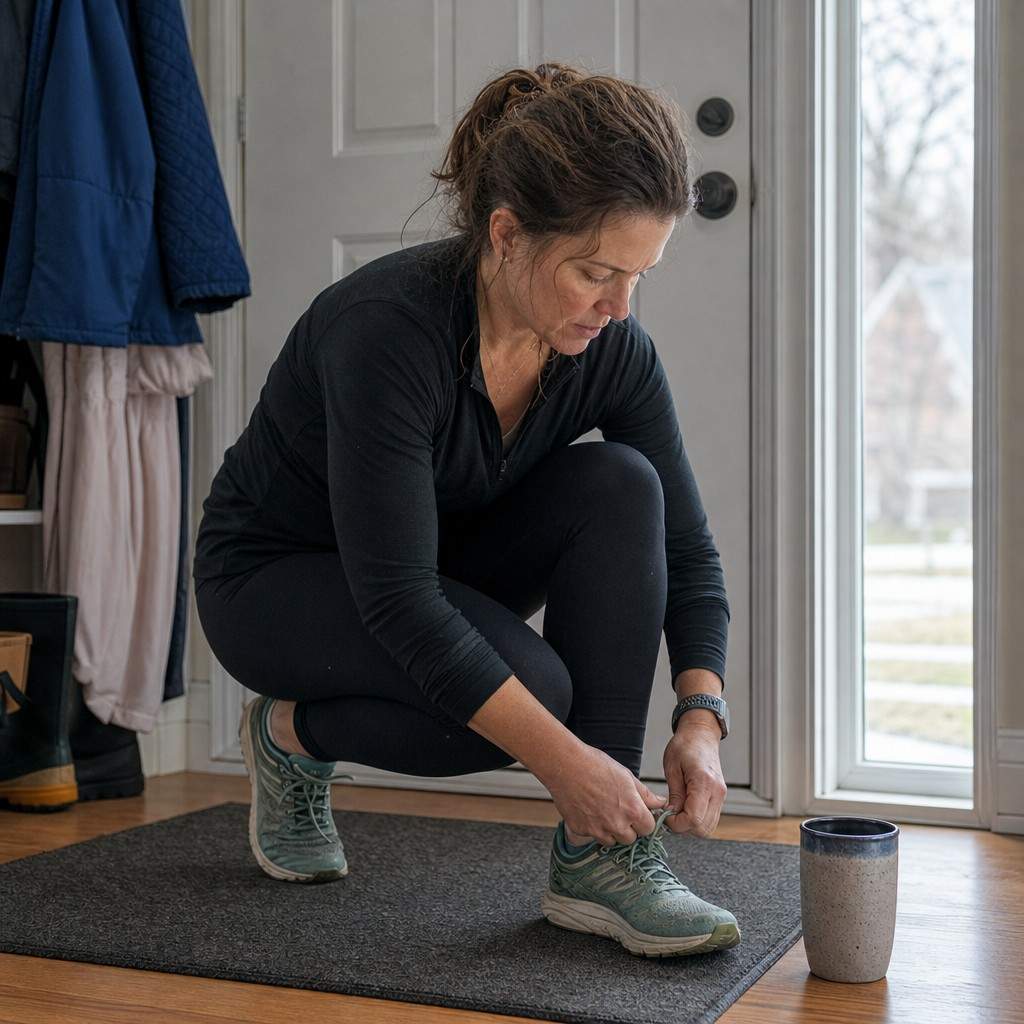
Running as hard as you can until you have to stop is one of the fastest ways to convince yourself that running is not for you. The run-walk method sidesteps this entirely.
You run for a short interval, walk for a short interval, and repeat. It is a legitimate way to run, not a compromise on the way to “real” running. The run-walk approach explained in this article covers why it works and how to start. The short version: walk breaks keep your effort in a range that actually builds fitness, and you finish feeling worked rather than wrecked.
Three run-walk sessions a week, at an easy conversational effort, will do more for your fitness over a month than one hard effort you dread repeating.
Plan for the weeks life gets in the way
This is the piece most habit advice skips. A system that only works when everything is going well is not a habit. It is a temporary streak.
Build a minimum viable version of your run ahead of time, something so small you could do it almost no matter what. Fifteen minutes counts. Walking most of it counts. The run you do on a hard Tuesday when you are short on sleep is the one that tells your nervous system: this is who I am now. I am someone who runs.
Missing one run does not break a habit. Missing three in a row, because you had no plan for the bad week, usually does.
Think about which runs are most at risk in a typical month. Is it the end of the work week? School breaks? Traveling? Identify those gaps now and decide in advance what the small version looks like for each one.
Track your consistency, not your pace
Early runners often focus on pace or distance, which are the numbers most likely to discourage you at the start. A better thing to track is whether you showed up.
A simple check-box, a training log, a note in your calendar. Marking three runs in a week is useful data. Seeing a streak develop is genuinely motivating. And when you miss a run, writing down why takes it from a vague sense of failure to a concrete thing you can actually look at.
The case for keeping a training journal goes into this more fully, but the short version is that the log is not about accountability. It is about understanding your own patterns.
Let the identity catch up
At some point, something shifts. You stop thinking of yourself as someone who is trying to get into running and start thinking of yourself as someone who runs.
That shift does not happen by hitting a mileage goal. It happens by showing up enough times that it becomes part of how you describe yourself, at least to yourself.
Consistency beats intensity. The runner who gets out three times a week for a year is in a completely different place than the one who ran hard for six weeks in January. Pace, distance, and how long you have been at it do not decide whether you are a runner. Running does.
Start with the smallest version you can repeat. Build around your existing routine. Have a plan for the hard weeks. The habit follows from those three things more reliably than it follows from motivation.
Recent Comments